Tales of a Librarian-in-Training

Tales of a Librarian-in-Training

Tuesday, September 13, 2016

Book Review: How They Croaked: The Awful Ends of the Awfully Famous


How They Croaked: The Awful Ends of the Awfully Famous by Georgia Bragg. Illustrated by Kevin O'Malley.

Published by Walker & Company in 2011.
Age level: 10-14; grade level 5 and up.

Summary: How They Croaked is an often humorous (yes, humorous!) take on the deaths of famous people throughout history. Puns are placed in each chapter, and each chapter also contains an  tongue-in-cheek heading, which might seem a bit distasteful for some, but isn't meant to offend. An example would be Marie Curie's, which says, "You glow, girl."  Each chapter describes in depth how each person died, and there is also a factoid sheet at the end of each chapter. The book is illustrated and
around 184 pages, with an index.

The authors are pretty straightforward in the very beginning:


My thoughts: Simply put: I *loved* this book. It might seem ghoulish or morbid to enjoy a book about death as much as I did, but the author has written a book dealing with death that probably will cause the reader to laugh out loud several times-like I did. Death is often a touchy subject with youth, but there will always be a natural curiosity, especially if it is being discussed in school or in a historical context. The "factoids" at the end of each chapter are also meant to make the reader giggle, such as on page 40, when talking about Henry VIII. Bragg writes in a box of the "Things that weigh as much as Henry VIII" when he died, including "244 regulation basketballs," "58,060 U.S. pennies," and lastly, "Jabba the Hutt."

Each chapter is short, at around 7 or 8 pages each. The author carefully uses terms and words that youth of today will recognize and identify with. In the chapter about Cleopatra, the author describes her style as "big, with a lot of bling. If you're a girl it's fun to be her on Halloween, with her black eye makeup and distinctive hairdo" (Bragg 19). Another chapter I found particularly amusing was the one about Charles Dickens. Dickens, who was not known to be an overly pleasant man, often berated his children and gave them nicknames such as "Chickenstalker" or "Flaster Floby." Bragg writes "The kids' nicknames for Dad could be have been Shutyourwordhole or Getoveryourself."

The illustrations match the tone of the book, and the artist, Kevin O'Malley, puts a special "spin" on each portrait.

As well as illustrations and charts, such as this one detailing Henry the VIII's wives:


Of Note: The book has been nominated for numerous awards, including the North Carolina Children's Book Award, the Truman Readers Award, and the Cybilis Award for Non-fiction, which int won. It is also a ALA Notable Children's Book and a Quick Pick Book for Reluctant Young Adult Readers (as picked by YALSA).

Further Resources: I was delighted to find out that the author has another book out, titled How They Choked: Failures, Flops, and Flaws of the Awfully Famous. There is also a brief and interesting interview with NPR conducted with the author and can be found here: here. The author herself has included a "further reading" appendix in the back of the book, for those who wish to continue their morbid history lessons.

In conclusion: For students who are fans of "gross out" humor and facts, this is the book for them.

Sunday, September 4, 2016

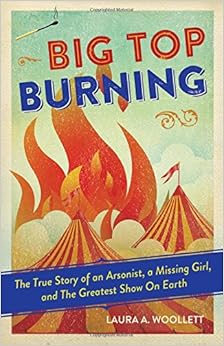
Book Review: Big Top Burning by Laura A. Woollett


image from Amazon.com

Big Top Burning: The True Story of an Arsonist, a Missing Girl, and the Greatest Show on Earth by Laura A. Woollett.

Published by Chicago Review Press in 2015.
Age level 10 and up; grade level 5 and up.

Summary: Big Top Burning is an examination of the 1944 Ringling Bros. Barnum & Bailey circus fire in Hartford, Connecticut. The book traces the history of the fire, the victims and survivors, and possible theories as to how the still unsolved disaster started. The fire killed 167 people, and injured 682. The book is 167 pages long, but contains a lot of information for a young reader. There are images included, as well as an index.

My thoughts: Woollett does a fine job of going back to that tragic day in history, by writing about different families who were attending the circus that day. The book appeals to a wide audience-children who like reading about history, who are curious about how the circus was in the past, and even youth who like mysteries or detective stories. At one point Woollett, when describing the mystery of "Little Miss," an unidentified victim of the fire, goes into detail about forensics, and identifying her body, which surprised me. The dental chart of the victim is even included. At first I thought it might be a bit heavy for a young reader, but there are youth who like to read about true crime and detective stories, and the chapter talking about "Little Miss" will surely keep their interest.

The fire itself takes up about half of the book, with the other half delving into how the fire was started, who might have started it, and stories of the survivors and victims' family members. The book is very well organized, in chronological order from the beginning of the day when families set out to see the circus, to modern times and the still present mystery of the fire.

There are many black and white photographs in the book, including the one below of famous Ringling Bros. clown Emmett Kelly Jr., carrying a bucket of water to help douse the flames. With the bleachers burning in the background, Kelly's full clown makeup and dress make up an almost surreal image. A clown, who many associate with laughter and joy, carrying a bucket of water while smoke lingers in the background.


The image of the scene after the fire is particularly devastating.


Personally, I found the book very interesting. Living so close to Hartford (about 20 miles) the subject of the fire comes up all the time and always piques my curiosity. I had seen an excellent exhibit about the fire two years ago at a state fair, and always wanted to learn more. It might be hard for youth of today to relate to the circus from years ago, since almost all big events are now held in a stadium of some kind, but Woollett really gives great detail about how the circus would travel by train, set up a tent, and how the operations would work back in 1944. It is a great piece of narrative non-fiction, and it made me want to read more about the fire.

There are many websites dedicated to the history of the fire and the victims, but I did not come across any that would be a very good companion to this book. Some of the websites I encountered included graphic images that might be upsetting to young readers. Similar books that young readers might enjoy include Fatal Fever: Tracking Down Typhoid Mary by Gail Jarrow, Titanic: Voices from the Disaster by Deborah Hopkinson and even the I Survive fiction series.